Modern cold-climate heat pumps have quietly rewritten the rules for foothill heating, and El Dorado County homeowners from Pollock Pines to Placerville deserve a straight answer about whether one can actually hold the line when overnight temps drop into the 20s. The short version: the right heat pump, properly sized and installed, can handle most El Dorado County winters without breaking a sweat. There are real variables worth understanding before you commit, though, and elevation is the first one worth talking about.
How El Dorado County Winters Actually Test a Heat Pump
El Dorado County foothill communities experience genuine sub-freezing nights. Pollock Pines regularly hits the low 20s. Even lower elevations like Placerville and Shingle Springs dip into the upper 20s on cold snaps that can last several days. These temperatures sit right at the threshold where heat pump performance becomes a real question worth answering before you commit to a system. Not a reason to rule one out, but a reason to choose carefully and work with someone who actually knows the local climate.
Elevation Makes a Real Difference
Pollock Pines sits at roughly 4,000 feet. Placerville is closer to 1,800 feet. That gap matters a lot when you're talking about heating capacity. A system sized for a milder foothill climate may underperform at higher elevations where sustained cold is more common. A proper load calculation accounts for your home's altitude, square footage, insulation levels, window area, and air leakage. Not just the square footage on your property tax bill.
What 20–30°F Means for Your Heating System
For a conventional furnace, 25°F outside is just another cold night. For a standard heat pump, that same temperature can push the system to its limits. The critical factor is how your specific equipment is rated to perform at low ambient temperatures. Older or entry-level heat pumps were never designed for sub-freezing air. Cold-climate models are. Knowing which category your system falls into, or which you're considering, changes everything about what you can realistically expect. Explore heating services for El Dorado County homes to understand the options available for foothill properties like yours.
Standard Heat Pumps vs Cold-Climate Heat Pumps at Sub-Freezing Temps
A standard heat pump typically loses significant efficiency below 35–40°F and may struggle to maintain indoor comfort on its own below freezing. Cold-climate heat pumps are engineered differently. They extract usable heat from outdoor air down to 5°F or lower, making them a genuinely viable primary heating source for most El Dorado County elevations during a typical winter freeze. The technology behind this is variable-speed compressor design, which lets the system ramp up capacity as outdoor temps fall rather than hitting a hard cutoff.
Where Older Equipment Falls Short
Single-stage heat pumps from 10 or 15 years ago were built around a narrower operating range. They work well enough when outdoor temps hover in the 40s. Drop below that and they can't ramp up capacity to compensate. The result is a system that runs constantly, can't quite reach the thermostat setpoint, and eventually hands off to electric resistance backup strips. Effective, but expensive to run. That's not a failure of the heat pump concept. It's a limitation of older equipment that cold-climate models have largely solved.
What Cold-Climate Models Are Rated to Handle
Leading cold-climate heat pump lines are rated to deliver full or near-full heating capacity at 17°F and meaningful output down to 5°F. Some models push that floor even lower. That performance envelope covers virtually every temperature El Dorado County homes encounter in a typical winter, including the multi-day cold snaps that catch homeowners off guard. For deeper reading on how these systems perform in the field, the heat pump service and performance guides on the Jonas Energy blog are a solid starting point.

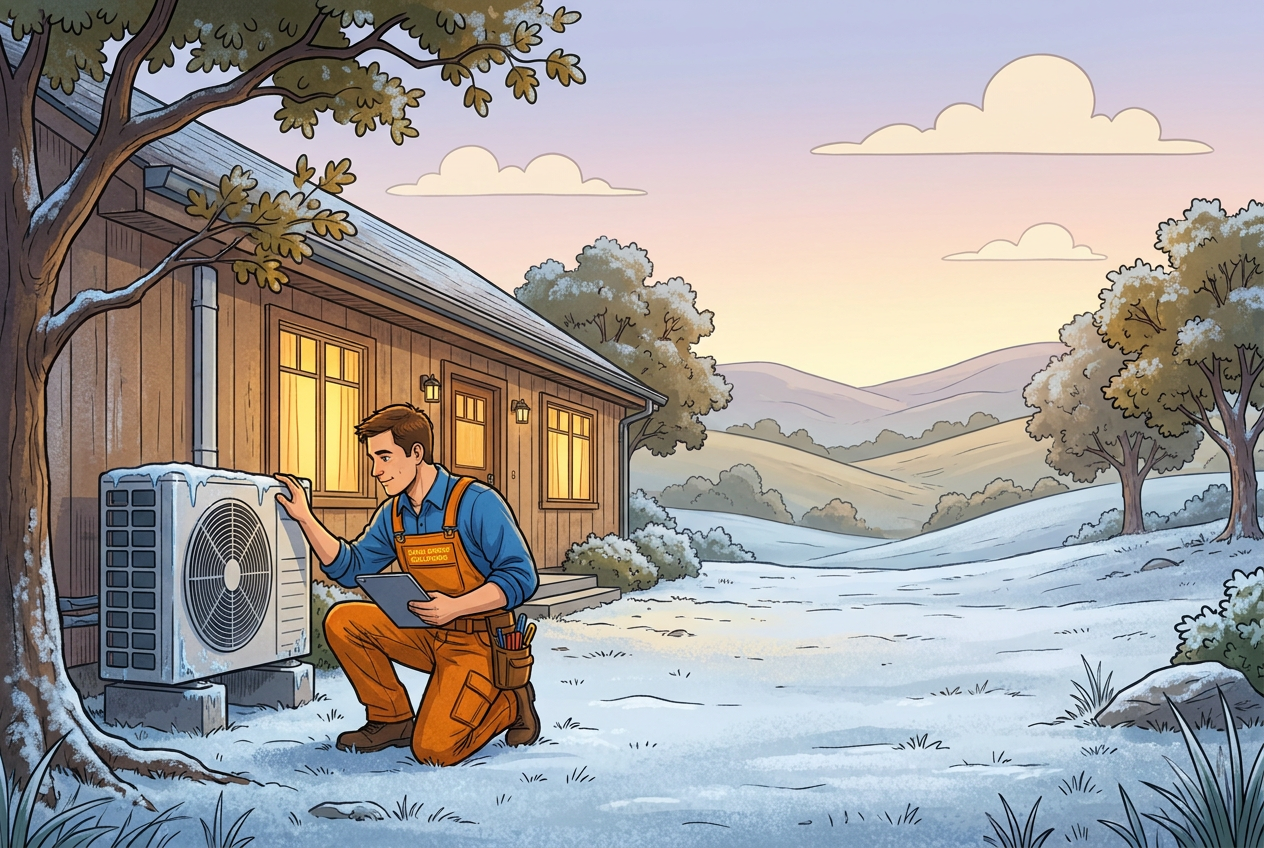
A cold-climate heat pump running a defrost cycle on a frosty foothill morning. A normal part of operation at sub-freezing temperatures.
What to Realistically Expect During a 20–30°F Freeze
Longer runtimes. That's the most noticeable change when temps drop into the 20s. A cold-climate heat pump doesn't cycle on and off as frequently as a furnace. It tends to run at a lower, steadier output for longer periods. That's actually more efficient than short blasts of high heat. Your home stays at a more consistent temperature, and the system works within its design parameters rather than fighting against them. Check the HVAC heating and cooling services page for more on how modern systems handle seasonal extremes.
Runtime and Efficiency at Low Temperatures
Efficiency does drop as outdoor temperatures fall. A system that delivers 3 units of heat per unit of electricity at 47°F might deliver closer to 1.5 to 2 units at 17°F. Still more efficient than electric resistance heat, which delivers exactly 1 unit per unit of electricity. The practical takeaway: your electricity use will go up during a hard freeze, but a well-sized cold-climate heat pump should still maintain your setpoint without switching entirely to backup strips.
Defrost Cycles and What They Look Like
When outdoor temps hover around freezing, moisture in the air can frost over the outdoor coil. The system handles this automatically, briefly reversing its cycle to melt the frost. You may notice steam rising from the outdoor unit and a short pause in heating output. Normal. Expected. Not a sign of a problem. The defrost cycle typically lasts a few minutes and happens periodically throughout a cold day, not constantly. If your unit seems to be defrosting for extended periods or failing to recover, that's worth a service call.
- Longer, steadier runtimes replace short on/off cycles. This is normal and efficient.
- Steam or vapor from the outdoor unit during defrost is expected, not a malfunction
- Indoor temperatures may take slightly longer to recover after a door or window is left open
- Efficiency decreases as temps fall, but a properly sized cold-climate unit should still maintain your thermostat setpoint
- Electric backup strips may engage briefly during the deepest cold snaps. That's what they're there for.
When a Backup Heat Source or Dual-Fuel Setup Makes Sense
A cold-climate heat pump handles most El Dorado County winters on its own. Homes at higher elevations like Pollock Pines, older housing stock with poor insulation, or properties that see extended multi-day freezes below 15°F may benefit from a dual-fuel setup, pairing the heat pump with a gas or propane furnace that kicks in only when outdoor temps drop to a set threshold. This isn't a compromise. It's a deliberate design choice that gets you the efficiency of a heat pump for 90% of the heating season and the raw capacity of a furnace for the coldest days.
The crossover point, the outdoor temperature at which the furnace takes over, can be set based on your local climate, utility rates, and comfort preferences. For most El Dorado County homes, that threshold falls somewhere between 15°F and 25°F. Getting it right matters. Set it too high and you waste the heat pump's efficiency advantage. Set it too low and you put undue strain on the heat pump during extreme cold. The heating system options and comparisons available through Jonas Energy cover dual-fuel configurations in more detail.

A pre-freeze system check ensures your heat pump is sized, charged, and ready before temperatures drop into the 20s.
Five Things to Check Before Relying on a Heat Pump Through a Freeze
Preparation matters more than equipment brand. A well-maintained mid-tier system will outperform a neglected premium one when temperatures drop. Before the next freeze arrives, run through this checklist, and if anything on it prompts a question, it's worth having a technician take a look. A proactive HVAC maintenance plan can catch most of these issues before they become cold-night emergencies.
- Confirm your system is rated for cold-climate operation. Check the manufacturer's spec sheet for rated capacity at 17°F. If you don't have it, your installer or a service technician can pull it up.
- Verify refrigerant charge. Low refrigerant is one of the most common reasons a heat pump underperforms in cold weather. This requires a licensed technician to check and correct.
- Clear the outdoor unit. Leaves, debris, or overgrown vegetation around the unit restrict airflow and reduce efficiency. Keep at least 18 inches of clearance on all sides.
- Check your air filter. A clogged filter forces the system to work harder and can reduce airflow enough to cause problems during a sustained cold snap. Replace it before the heating season starts.
- Test your backup heat. Whether you have electric resistance strips or a gas furnace as backup, confirm it operates correctly before you need it. Running a test cycle in October is far better than discovering a problem in January.
Getting the Right System Sized and Installed for Your Home
Sizing a heat pump for a foothill home in El Dorado County isn't the same as sizing one for a flat Sacramento Valley tract house. Elevation, home age, duct condition, insulation, window area, all of it feeds into a proper Manual J load calculation. Skip that step and you're guessing. A system that's undersized for your specific conditions will disappoint you on the coldest nights, and those are exactly the nights when you can't afford a disappointment.
Why Local Expertise Matters for Foothill Homes
Contractors who primarily work in milder climates may not account for the sustained cold that Pollock Pines or higher-elevation Diamond Springs properties see each winter. Local experience with foothill conditions directly affects which equipment gets recommended, how it gets sized, and how the installation is configured. Jonas Energy Solutions works in El Dorado County specifically, which means the team understands the climate variability across the county's elevation range, not just the averages. Financing options are available for qualified homeowners considering a new installation, and you can explore those through Jonas Energy's financing page.
Frequently Asked Questions
Will a heat pump work when it's 20°F outside in Pollock Pines?
A cold-climate heat pump is designed to operate effectively at 20°F and even lower. At that temperature, efficiency is reduced compared to milder conditions, but a properly sized cold-climate model should still maintain your indoor thermostat setpoint. Standard heat pumps without cold-climate ratings may struggle significantly at those temperatures.
What is a defrost cycle and should I be worried about it?
A defrost cycle is an automatic process where the heat pump briefly reverses operation to melt frost that has built up on the outdoor coil. You may see steam rising from the unit and notice a short pause in heating. This is completely normal and expected during cold, humid weather. It typically lasts a few minutes and does not indicate a malfunction.
Do I need a backup heat source with a cold-climate heat pump?
Most cold-climate heat pumps include electric resistance backup strips as a built-in safeguard. For homes at higher elevations or with older insulation, a dual-fuel setup pairing the heat pump with a gas or propane furnace can provide additional capacity during the deepest cold snaps. Whether you need it depends on your home's specific characteristics and your local climate.
How do I know if my current heat pump is a cold-climate model?
Check the manufacturer's specification sheet for rated heating capacity at 17°F. Cold-climate models will show meaningful output at that temperature, often close to their rated capacity. If you can't locate the spec sheet, a licensed HVAC technician can identify your equipment and pull the performance data.